Boxlune
Quantum Sphere
Quantum Sphere
Couldn't load pickup availability
Self-paced learning overview
- 📥 Digital file available after purchase
- ♾️ Long-term availability
- 🔒 Secure checkout
- 📅 Content updated in 2026
1. Problem Statement
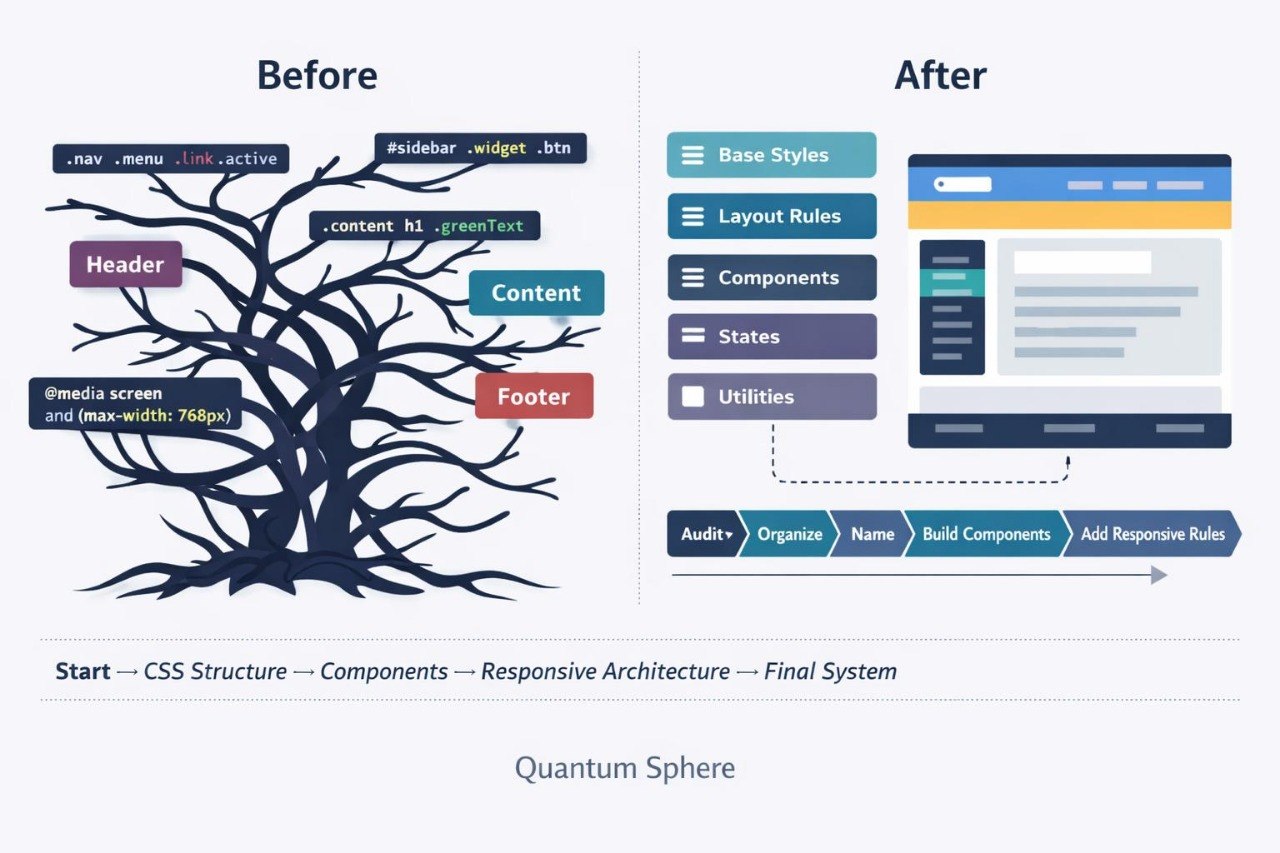
Struggling to maintain CSS when a page contains many components, states, and layout variations? You’re not alone: as the number of rules grows, specificity conflicts, repeated values, and unexpected changes may appear across related sections. Individual components may also follow different naming, spacing, and responsive principles. Revising one block can affect another area when the relationships between rules have not been planned. Quantum Sphere helps organize styles as a connected system with defined layers, components, and review practices.
2. Solution
This course will teach you how to plan CSS architecture for pages containing many related elements. You will examine how to separate base styles, layouts, components, states, and utility rules. Dedicated modules explain specificity, cascade order, naming systems, and shared value management. Practical assignments include reviewing existing CSS, rebuilding components, and forming a responsive page system. In the final assignment, you will assemble a complete style library and apply it to a detailed multi-section layout.
3. What’s Inside
Module 1: Existing Style Review
Learn how to identify duplicate declarations, conflicting rules, unused selectors, and recurring values. The module provides a structured sequence for reviewing a stylesheet before reorganizing it.
Module 2: CSS System Architecture
Separate rules into base settings, layouts, components, states, and utility classes. This structure clarifies the purpose of each stylesheet section.
Module 3: Cascade and Specificity
Study why some declarations take priority over others. You will analyze selector conflicts and reduce dependence on overly complex selector structures.
Module 4: Naming System
Create consistent names for sections, components, internal elements, and states. The assignment replaces unrelated naming choices with an organized structure.
Module 5: Shared Values and Variables
Build value groups for colors, typography, spacing, dimensions, borders, and motion settings. Revising a shared value will update related components.
Module 6: Component Construction
Develop buttons, cards, information panels, navigation blocks, and fields with a shared internal logic. The module also covers variations and states for each component.
Module 7: Combined Components
Join several smaller elements into larger page sections. Examples include card catalogs, comparison areas, forms, and structured information regions.
Module 8: Layout Systems
Combine containers, flexible rows, and grid structures. You will determine which layout approach fits different forms of content.
Module 9: Responsive Architecture
Create component arrangements for wide, medium, and narrow widths. The focus remains on maintaining a logical content sequence.
Module 10: States and Motion
Add hover, focus, pressed, and inactive states. Transitions and animations will use shared duration and pacing values.
Module 11: CSS Code Review
Check for repetition, overflow, conflicts, unnecessary nesting, and unused declarations. The module includes a checklist for reviewing the complete page.
Module 12: Final CSS System
Create a multi-section page containing navigation, cards, text areas, a form, and a closing section. The final assignment combines architecture, components, responsive behavior, and interaction states.
4. Who Is This For?
✅ This course may suit you if you:
- already create responsive pages with several sections;
- work with libraries of recurring components;
- want to organize a large CSS codebase;
- would like to understand cascade and specificity in greater detail;
- plan to create connected styling systems.
❌ This course may not suit you if you:
- are beginning your introduction to CSS;
- have not worked with grids or responsive rules;
- need only foundational text styling;
- are looking for materials outside web styling.
5. What You’ll Learn
- Conduct a structured stylesheet review.
- Divide rules into at least five functional groups.
- Identify and revise specificity conflicts.
- Create a consistent naming system.
- Build a library of shared CSS variables.
- Develop at least twelve connected components.
- Combine components into detailed page sections.
- Select between flexible and grid-based layouts.
- Configure three responsive structural arrangements.
- Create shared rules for interaction states.
- Reduce duplicate and unused declarations.
- Document the structure of a CSS system.
- Assemble a multi-section page under one set of styling rules.
6. 30-Day Refund Policy
A refund request may be submitted within 30 days, subject to the Boxlune store policy. The request procedure, review conditions, and possible exceptions are presented on the dedicated refund policy page.
7. Certificate
After completing the required modules and final CSS system assignment, the learner may receive a Boxlune certificate. The document confirms completion of the Quantum Sphere learning program.
1. How is the learning process organized?
1. How is the learning process organized?
The materials are divided into sequential modules with explanations, examples, and practical tasks. Learners can study at their own pace and revisit earlier sections for review.
2. Is previous CSS experience required?
2. Is previous CSS experience required?
The recommended background depends on the selected tier. Introductory courses explain foundational concepts, while later tiers cover broader topics, more detailed layouts, and deeper styling practices.
3. What is included in the learning materials?
3. What is included in the learning materials?
Each tier contains topic-based modules, written explanations, code examples, exercises, and final tasks. The amount and depth of the material increase according to the tier.
4. Is a certificate included?
4. Is a certificate included?
Yes. A Boxlune certificate is provided after the required modules and course assignments have been completed.
Share